

A mistake from your past does not eliminate your right to defend your future. A charge for possession of a firearm by a convicted felon in Florida carries serious consequences, but the state must still prove every element with lawful, reliable evidence.
Facing a firearm possession charge? Call Galanter Law at (305) 576-0244 for a confidential case review.
Many people do not realize how broad the legal definition of possession is under state law. Understanding what Florida law prohibits is the first step in preparing a defense. The questions often involve a person’s record, knowledge, control, and how police obtained the evidence.
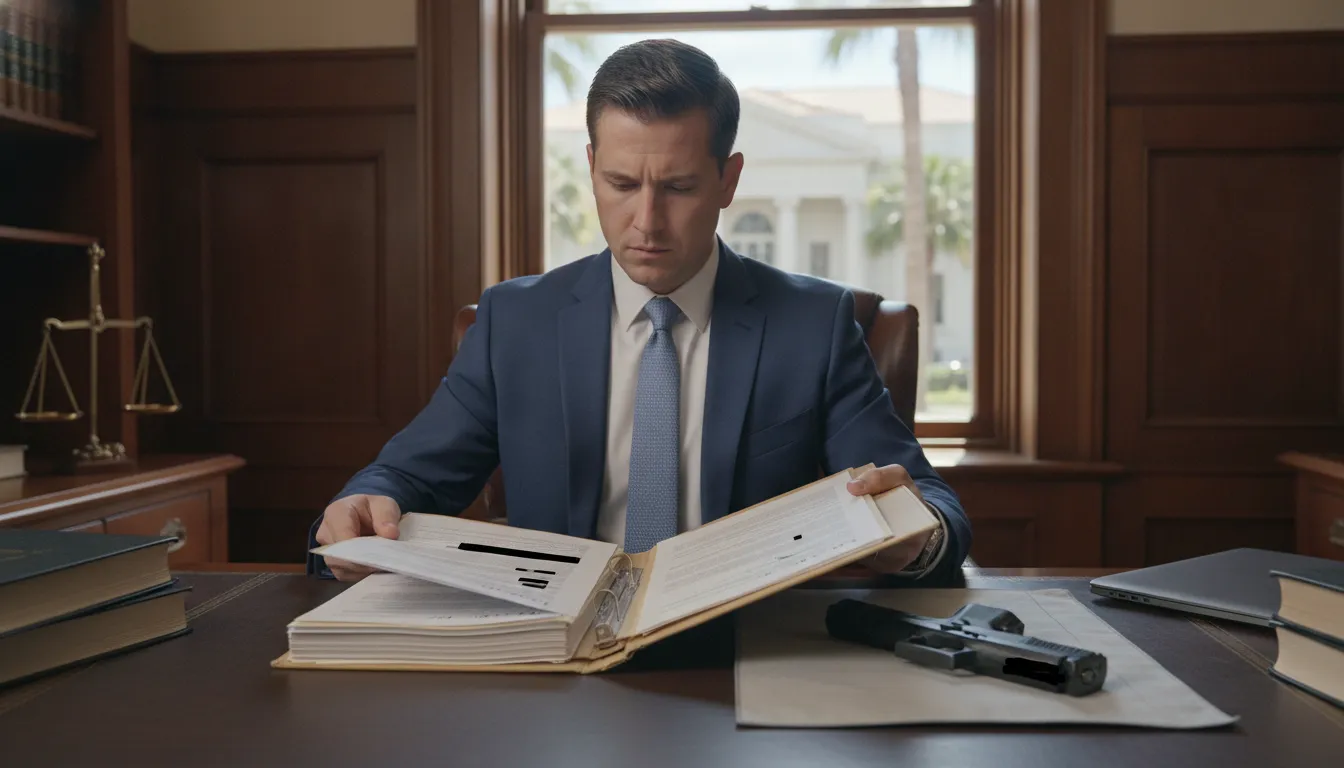
What does possession of a firearm by a convicted felon Florida law prohibit?
Florida Statute 790.23 generally prohibits a person with a qualifying felony record from owning or controlling a firearm, ammunition, or electric weapon. Prosecutors must prove a covered status and knowing possession. The evidence and available defenses depend on the record, location, access, police conduct, and other case-specific facts.
The core rule under section 790.23
Florida Statute 790.23 bars certain people with felony records from owning or having a firearm, ammunition, or an electric weapon or device. The rule can apply after a Florida felony conviction and in other listed situations. The exact record, jurisdiction, and later legal action all matter, so a lawyer should review certified records rather than rely on memory.
The statute is broader than carrying a gun in public. A charge may arise from a firearm found in a home, car, bag, or other location if the state claims the accused knowingly controlled it. The government must still prove each required element beyond a reasonable doubt.
Who may fall within the statute
The law identifies several categories, including people convicted of a felony in Florida and people found guilty of qualifying offenses elsewhere. It also addresses some delinquency findings and other specified statuses. Whether an old case qualifies may turn on the judgment, the date, and what rights were restored.
Rights restoration is a fact-specific legal issue. A person should not assume that finishing a sentence, moving to Florida, or receiving another civil right automatically restores firearm rights. Counsel can compare the record with the current statute and any controlling restoration documents.
What the prosecution must prove
A prosecutor generally needs proof of a covered status and knowing possession, custody, control, or ownership of the item. The state must also show that the item fits the law. Disputes may concern the accused person’s knowledge, access, control, or the reliability of the state’s evidence.
Because weapons cases may involve separate allegations, readers can also review Galanter Law’s page on possession of a weapon during a crime. That service page covers a broader weapons issue, while this guide focuses on the felon-in-possession charge.
How do actual and constructive possession differ?
Actual possession generally means the firearm was on the person or within ready reach and under that person’s control. Constructive possession concerns a firearm found elsewhere. In constructive-possession cases, prosecutors typically rely on evidence of knowledge plus the ability to control the firearm.
The word possession does not always mean a firearm was in someone’s hand or pocket. Florida cases may involve actual possession or constructive possession. The difference can shape which facts become central to the defense.
| Issue | Actual possession | Constructive possession |
|---|---|---|
| Location | On or very near the person | In another place the person allegedly controls |
| Main proof | Direct physical custody | Knowledge plus the ability to control the item |
| Common dispute | Identity or legality of the search | Knowledge, access, or control |
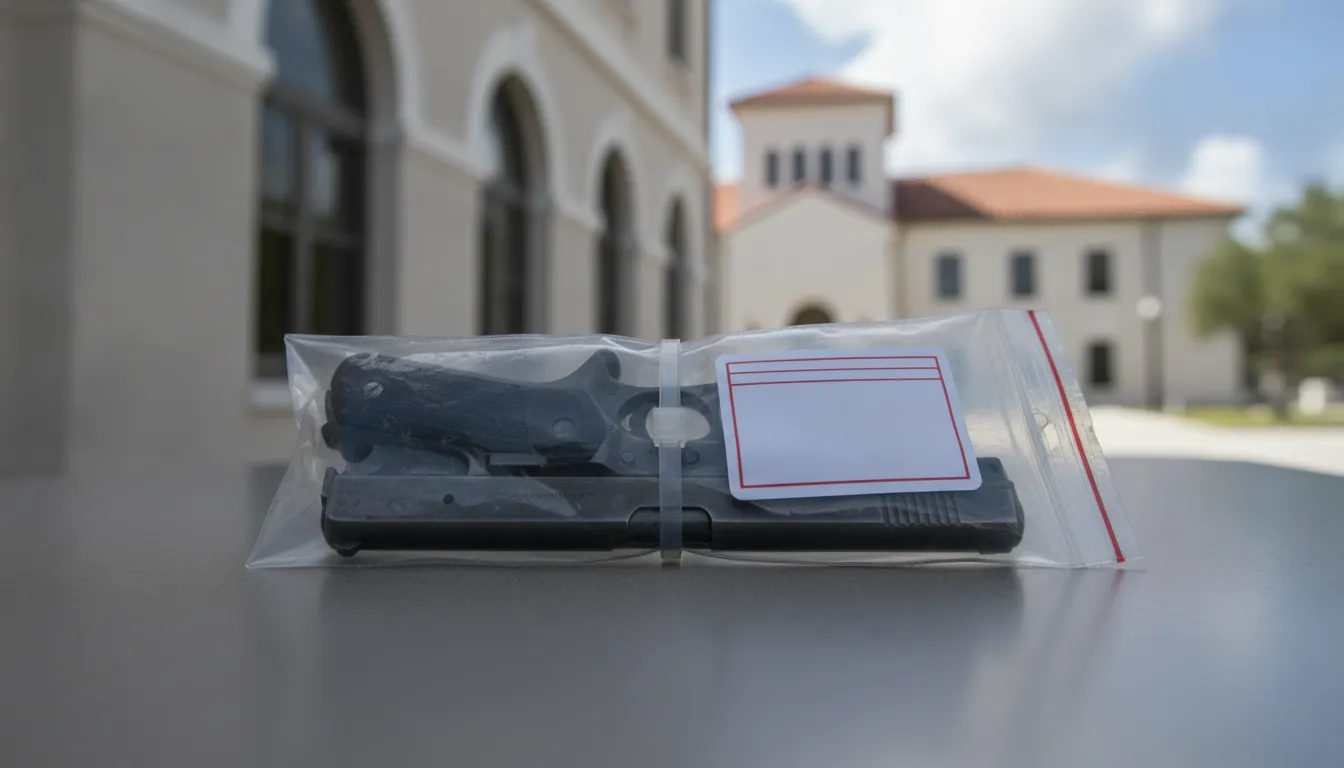
Actual possession
Actual possession usually means the firearm is on the accused person, in the person’s hand, or within ready reach and under that person’s control. Body-camera footage, officer testimony, fingerprints, and the details of a search may become important. A lawyer can test whether the search and seizure complied with constitutional rules.
Constructive possession
Constructive possession may be alleged when a gun is found elsewhere, such as in a vehicle, bedroom, or shared home. Mere closeness is not always enough. The state may need evidence that the accused knew the gun was there and could exercise control over it.
Shared spaces can create major proof questions. If several people had access to a car or room, ownership and control may not be clear. Messages, statements, keys, storage records, DNA, fingerprints, and witness accounts may help or hurt the state’s theory.
Why the distinction matters
The strongest defense often depends on how the prosecution claims possession occurred. Counsel can map every piece of proof to the required elements, challenge unsupported inferences, and identify facts that point to another person or a lack of knowledge.
What penalties can follow a conviction?
A violation of Florida Statute 790.23 is generally a second-degree felony. Which can expose a person to up to 15 years in prison and a fine up to $10,000. Other sentencing provisions may apply depending on actual possession, prior record, and the specific facts.
A conviction brings serious legal consequences. Florida law sets strict sentencing rules, but the applicable range depends on the charge, proof, prior record, and other case-specific circumstances. Understanding those risks is important when evaluating the defense.
Prison time and fines
In Florida, this crime is often a second-degree felony. Under Florida Statute 790.23, a court can sentence you to a term of up to 15 years in state prison. Along with prison time, you may have to pay a large fine. The law allows for fines up to $10,000 for this level of felony. These costs can change based on your past record and the facts of your case.
Mandatory prison terms
One of the most serious parts of this charge is the mandatory term. If a court finds actual possession, a three-year mandatory prison term may apply. The precise sentencing consequences depend on the proven facts and governing law. This makes it important to work with an experienced Florida criminal defense attorney who can evaluate the evidence and sentencing exposure.
Factors that raise penalties
Some facts can make the penalties even worse. If you have certain past crimes or gang ties, the state can raise the charge to a first-degree felony. A first-degree felony can lead to a sentence of up to 30 years or life in prison. Your team must look at every detail to see if the state is pushing for these high terms. Early legal help is the best way to guard your rights and your future.
What defenses may apply to a firearm possession charge?
A felon-in-possession charge is serious, but the state must prove several facts. A legal team can examine the details for weaknesses in the proof. Potential issues include how police found the firearm, whether the accused knew about it, and whether the accused could control it. Every defense depends on the evidence.
Fighting the possession claim
The state must show that you had possession of the firearm. In Florida, this can mean actual or constructive possession. Actual possession generally means the gun was on you. Constructive possession may mean the gun was in a place you controlled and you knew it was there. A lawyer from Galanter Law’s criminal defense practice can test whether the evidence supports those elements.
Knowledge is a key part of the case. If you did not know the gun was in your home or car, you might have a defense. Many cases involve guns found in shared spaces. If the state cannot link the gun only to you, their case may be weak. Proving you did not have full control is a common way to fight these charges.
Proof problems can also help your case. Police must handle the gun and other items with great care. If the paper trail is broken, the items might not be used in court. Also, if there are no prints or DNA on the gun, it is harder to prove you held it. Lawyers look for these gaps to create fair doubt.
Checking your past record
To find you guilty, the state must prove you were a convicted felon. This is a vital part of the charge. If your past crime was set aside, you may not fit this status. Sometimes, a person gets their civil rights back before the arrest. Florida law needs proof of a valid felony record at the time you had the gun.
Under Florida Statute 790.23, it is against the law for anyone with a felony record to own a gun. But if that record is for a crime that was later changed, your lawyer might fight the charge. They will check your past cases to ensure everything is correct. Any error in your record could change the outcome of your new charge.
Unfair search and seizure
The Fourth Amendment protects people from unreasonable searches by the police. If officers obtained the firearm during an unlawful search, counsel may seek to suppress the evidence. Whether a court excludes evidence depends on the facts, the legal basis for the search, and applicable exceptions.
Police generally need a warrant or a recognized legal basis to search a car or home. Your lawyer can review reports, video, warrants, and testimony to assess whether officers followed the law. Suppression issues are case-specific and do not guarantee dismissal.
Getting back your gun rights
Some rare cases allow a person with a felony to have a gun. The most common is getting back your civil rights. This process is hard and needs proof from the state board. If you got your rights back, you must show the proper papers to prove you are not breaking the law.
Some people think their rights come back as soon as they finish their time. In Florida, this is not true for gun rights. You must go through a specific legal process to get those rights back. A lawyer can help check your status and see if you have a valid defense. This check is a key step in building your plan.
Questions about the evidence or your prior record? Call Galanter Law at (305) 576-0244 for a confidential consultation.
What should you do after an arrest or investigation?
Early choices can affect the evidence and the defense. A person facing an investigation should act carefully, avoid trying to explain the case alone, and seek advice tailored to the facts.
- Use the right to remain silent. Give basic identifying information when legally required, but do not discuss ownership, access, or who knew about the firearm without counsel.
- Do not touch or move alleged evidence. Trying to relocate a firearm can create new risks and may change the evidence.
- Preserve helpful records. Keep lawful records such as vehicle use logs, leases, messages, receipts, and rights-restoration papers. Do not edit or delete anything.
- Avoid contacting witnesses about testimony. Do not ask anyone to change a statement or coordinate an account.
- Speak with a defense lawyer promptly. Counsel can review deadlines, bond terms, the search, and the state’s proof.
Follow all release conditions
Bond and release orders may restrict travel, contact, weapons, or other conduct. Read every condition and ask counsel about anything unclear. A separate violation can make the situation harder even when the original charge remains disputed.
Build an accurate timeline
Write a private timeline for counsel while events are fresh. Include who used the location, when officers arrived, what was said, and where items were found. Do not post the account online or send it to people who are not part of the legal team.
How does a defense lawyer evaluate the charge?
Reviewing status and court records
A careful review starts with the precise record the state relies on. Counsel may obtain judgments, sentencing documents, out-of-state records, and rights-restoration papers. This helps determine whether the prosecution can prove a status covered by the current law.
Testing the possession evidence
The lawyer can compare police reports, video, witness accounts, forensic results, and location evidence. The goal is to separate proven facts from assumptions. In a constructive possession case, access to a shared area does not answer every question about knowledge or control.
Reviewing the search and statements
Counsel may examine why officers stopped, searched, or detained the accused and whether a warrant or exception applied. Statements also require close review. If evidence was obtained unlawfully, the defense may have grounds to seek its exclusion, but the result depends on the facts and governing law.
No defense strategy fits every case. The right approach may involve motions, negotiations, preparation for trial, or several paths at once. A prompt review gives counsel more time to preserve evidence and address the charge. Learn more about Galanter Law’s criminal defense experience and approach, review the firm’s case results, or contact Galanter Law for a case-specific review.
Frequently Asked Questions
What counts as a firearm for a felon under Florida law?
Florida law defines covered items broadly. Under Florida Statute 790.23, the prohibition can include a firearm, ammunition, or an electric weapon or device. Whether a specific item qualifies and whether the state can prove possession require a fact-specific legal analysis.
Can a felon restore their gun rights in Florida?
Potentially, but the process is specific and can take time. Restoring firearm authority is not necessarily the same as regaining another civil right. A person should verify the status through official records before touching a firearm. If there is any doubt, an attorney can review the prior record and restoration documents.
Does every felon gun charge have a three-year minimum?
No. The three-year mandatory minimum may apply when the state proves actual possession under the governing sentencing provision. Constructive-possession allegations can present different sentencing questions. A lawyer should evaluate the charge, evidence, and current law before advising on possible exposure.
What is the maximum fine for a felon with a gun in Florida?
A second-degree felony can carry a fine up to $10,000 under Florida law. The actual sentence depends on the proven offense, criminal history, sentencing rules, and other facts. A case review can clarify the potential consequences.
Talk to a Florida criminal defense lawyer
A felon-in-possession allegation can involve serious penalties and fact-heavy disputes about status, knowledge, control, and police conduct. Galanter Law can review the specific charge and explain the available next steps.
Call (305) 576-0244 to schedule a confidential consultation with Galanter Law.
