

A criminal trial attorney is the lawyer who stands with you once a Florida case is actually tried, not only the lawyer who files papers before the first hearing. In a jury trial, that work includes selecting jurors, testing the State’s proof, deciding whether you testify, and arguing the case under Florida’s closing-argument rules. A bench trial puts the same decisions in front of a judge instead of a jury. Most cases never reach that point, but the people who do need to know what the courtroom day looks like before they choose counsel.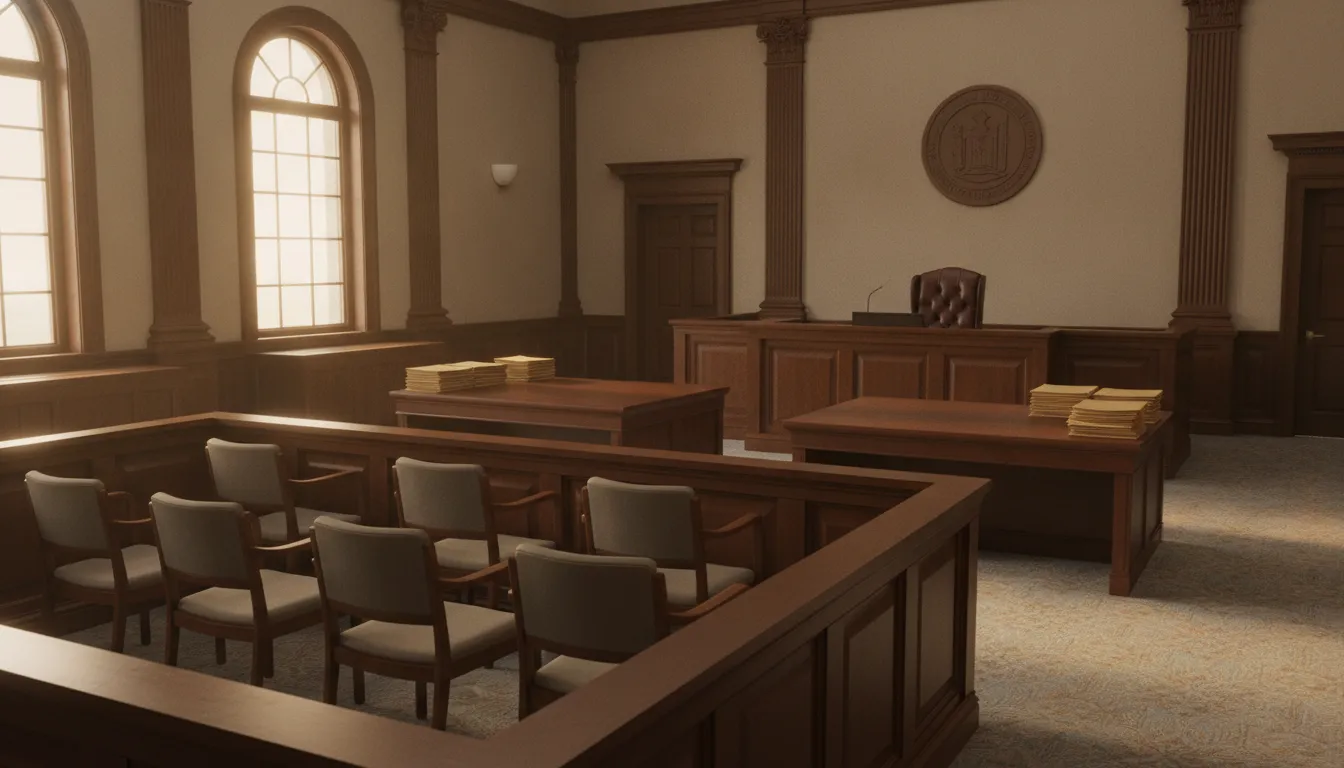 A Florida criminal courtroom before trial begins.
Call (305) 576-0244 to schedule a free consultation and review how a trial would work in your case.
This guide stays inside the courtroom. It does not repeat the pretrial path of first appearance, discovery, motions, and plea talks. That earlier sequence is covered in the Florida pretrial guide for a criminal trial lawyer. Trial work is one part of broader criminal defense representation, and the right lawyer depends on the court, the charge, and whether the case is heading to a jury.
What Does a Criminal Trial Attorney Do in Court?
A criminal trial attorney represents the accused during jury selection, the presentation of evidence, legal objections, and closing argument, then stays with the case through the verdict. The lawyer does not decide guilt. The jury does that in a jury trial, and the judge does it in a bench trial.
The job is narrower than “being a criminal lawyer.” Many criminal lawyers spend most of their time on bond, charging decisions, discovery, and negotiated resolutions. A trial lawyer has to be ready for the days when those paths end and the State calls its first witness. That readiness shows up in concrete work: a jury chart, a witness order, cross-examination outlines, and a plan for what happens if the State rests with a thin record.
Florida gives the accused a right to a speedy trial, and the Florida Supreme Court sets the procedures that carry that right out. The deadlines themselves belong in a separate discussion of the Florida speedy trial rule. What matters on the trial date is whether the lawyer in the courtroom can try the case that day, not only talk about trying it.
Galanter Law handles criminal cases in Miami-Dade and the surrounding courts. Yale Galanter’s background includes service as a prosecutor in the Miami-Dade State Attorney’s Office and decades of criminal trial work. That history is context for how the firm prepares a case. It is not a promise about the result in yours.
How Is a Jury Trial Different From a Bench Trial?
In a jury trial, jurors decide the facts. In a bench trial, the judge decides the facts and the law. Florida statute section 913.10 sets twelve jurors for a capital case and six jurors for every other criminal case.
A defendant may waive a jury in writing, with the consent of the State. The waiver has to be knowing and voluntary. A misdemeanor does not automatically become a bench trial, and a felony does not automatically require twelve people. The statute and the matching court rule both draw the line at capital cases versus all other criminal cases.
That choice changes the lawyer’s job. A jury needs a clear story, careful questions, and arguments that stay inside the evidence. A judge already knows the rules of evidence and will often want a tighter record and precise legal points. Neither format is automatically better. The charge, the court, the witnesses, and the defense theory all matter, and the decision belongs in a private review of the file.
Federal court is a different system, with its own jury rules and sentencing framework. If the charging document comes from a federal grand jury, read the firm’s federal crimes lawyer page alongside this guide. Do not assume a state-court jury practice maps onto a federal courtroom.
Who Speaks, and in What Order?
After the jury is sworn, the trial usually moves from opening statements to the State’s evidence, the defense case if there is one, then closing argument. The prosecutor speaks first and last in closing argument under Florida statute section 918.19.
| Stage | Who usually acts | What the stage is for |
|---|---|---|
| Jury selection. | Judge, both lawyers, and prospective jurors. | Seat a fair jury and remove people who cannot serve. |
| Opening statements. | Prosecutor, then the defense. | Preview the evidence. An opening is not itself evidence. |
| State’s case. | Prosecutor calls witnesses. Defense cross-examines. | The State must prove each element beyond a reasonable doubt. |
| Judgment of acquittal. | Defense may move. The court rules. | Ask whether the State’s evidence could support a conviction. |
| Defense case. | Defense, if it calls witnesses. | This stage is optional. The accused never has to testify. |
| Closing argument. | Prosecutor, then defense, then prosecutor rebuttal. | Argue what the admitted evidence does and does not prove. |
| Verdict. | Jury, or the judge in a bench trial. | The result is guilty, not guilty, or a hung jury. |
The order can shift if the court splits a legal issue from the jury, holds a hearing outside the jury’s presence, or the defense rests without calling anyone. Those are normal trial events, not signs that the case has gone off the rails. The lawyer should be able to explain each one in plain words before it happens.
Two points are easy to mix up. First, the State goes first because it has the burden of proof, not because the defense is expected to disprove the charge. Second, the prosecutor’s rebuttal is limited to answering the defense argument. It is not a chance to introduce new evidence.
How Does Jury Selection Actually Work?
Jury selection, often called voir dire, is the questioning of prospective jurors before any witness testifies. The goal is a lawful jury, not a room of people who already agree with the defense.
The judge and the lawyers ask about the charge, about experiences that could affect fairness, and about whether a juror can follow the law. Some people are excused for cause, meaning the court finds they cannot be fair. Each side also has a limited number of peremptory challenges, which remove a juror without stating that same cause. Those challenges still cannot be used to strike people because of race, ethnicity, or gender.
A criminal trial attorney prepares this stage before the panel walks in. Useful preparation includes the likely prosecution story, the defense themes that can be raised without previewing a witness who may never testify, and a written chart so strikes are not made from memory. The lawyer also has to watch the client. How a defendant sits, reacts, and dresses is visible to every juror, and the lawyer should say so before the morning of trial.
If the case involves a violent felony, the questions will often touch fear, weapons, and injuries. The charge-specific background for those cases lives on the violent crimes defense page. Jury selection itself stays about fairness, not about retrying the facts in the hallway.
What Happens When the State Presents Its Proof?
The State must prove every element of the charged crime beyond a reasonable doubt. The defense does not have to prove innocence, and the jury may not treat silence as evidence of guilt.
During the State’s case, the prosecutor calls witnesses and offers documents, photos, recordings, or physical items. The defense lawyer objects when the law requires it, cross-examines the witnesses the State calls, and keeps a record of what the jury actually heard. An objection that is never made can be difficult to raise later. An objection made only to interrupt can annoy the jury. Knowing the difference is part of trying the case.
Cross-examination is usually the defense’s first real chance to test a witness. Good questions are short, tied to a document or a prior statement, and aimed at one fact. Long speeches from the lawyer are not questions, and the judge can stop them. The point is to show what the witness does not know, what changed, or what the State left out.
When the State rests, the defense can ask for a judgment of acquittal. Florida’s rule lets the court enter that judgment if the evidence is not sufficient to support a conviction. The motion can be made at the close of the State’s case and again at the close of all the evidence. It is not a speech to the jury. It is a legal test of the record, made to the judge.
Drug cases often turn on this part of trial because the State’s proof may depend on a lab report, a search, or a witness who claims to have seen a hand-to-hand exchange. The elements of those charges are discussed on the drug crimes page. This article does not restate them.
Does the Accused Have to Testify?
No. In a Florida criminal trial the accused may testify, but no one can force that testimony, and the prosecutor may not comment on the decision to stay silent.
Florida’s rule on the accused as a witness is direct. If the defendant chooses to testify, the prosecutor may cross-examine like any other witness. If the defendant does not testify, that choice is not evidence, and the lawyer can ask the court to instruct the jury accordingly. The decision is personal to the accused. A lawyer can advise. The lawyer cannot make the choice for the client.
The practical tradeoff is easier to see with an example than with a slogan. Testimony can explain a gap that no document fills, such as why the accused was at a location or what words were actually said. Testimony also opens the door to prior statements, and sometimes to prior conduct the jury would not otherwise hear. A criminal trial attorney should walk through both sides with the actual discovery, not with a stock speech about “always” or “never” testifying.
Other defense witnesses are a separate choice. An alibi witness, a records custodian, or an expert may be useful even when the accused does not take the stand. Each witness has to be disclosed under the discovery rules and prepared on the facts they actually know. Putting an unprepared witness on the stand to fill time is a common way to hurt an otherwise careful defense.
How Should You Judge Trial Experience?
Ask what the lawyer has tried to verdict, in what court, and in what role. A long list of hearings is not the same thing as picking a jury and finishing a trial.
The Florida Bar offers board certification in criminal trial law for lawyers who meet published standards. Applicants need at least five years in practice and substantial involvement in criminal trial work. They also need at least 25 contested criminal cases, including 20 jury trials tried to a verdict, plus peer review, education hours, and a written exam. Certification is a credential. It is not required to try a case in Florida, and it is not a ranking of who will win.
Useful questions in a consultation are specific:
- How many jury trials have you taken to a verdict in the last five years, and were you lead counsel?
- Which of those trials were felonies, and in which Florida circuit?
- Who else would stand at the table, and who would question the main witness?
- Have you tried a case with this charge, this kind of evidence, or in this courthouse?
- Are you board certified in criminal trial law, and if not, what trial work do you actually do?
Compare that conversation with the broader choice between a public defender and a private lawyer. A public defender may have more trial repetitions than a private lawyer who rarely announces ready for trial. A private lawyer may have more time for one file. The label does not answer the question. The trial history does.
Also ask how the firm handles the morning of court. Someone should know the witness order, the exhibits, and where you need to be. If the answer is a promise of a particular verdict, treat that as a warning. No lawyer controls the jury.
Request a case review before the trial date if you want Galanter Law to look at the charge, the court, and the likely proof.
What Happens After the Verdict?
A not guilty verdict ends that charge. A guilty verdict moves the case to sentencing, and it can also open a narrow window to test the sufficiency of the evidence or to file an appeal.
If the jury cannot agree, the judge may declare a mistrial. The State can sometimes retry the case. That outcome is not an acquittal and it is not a conviction. The lawyer should explain the next date before you leave the courthouse.
Florida’s judgment-of-acquittal rule also allows a renewed motion within 10 days after a guilty verdict or after the jury is discharged, unless the court allows more time. That motion still asks a legal question: could the evidence support the conviction? It does not invite the judge to replace the jury because the defense disagrees with how the jury weighed witnesses.
An appeal is different again. It reviews the record for legal error. It is not a new trial with new witnesses. Timing, what was preserved by objection, and which court hears the appeal all matter. The firm’s Miami criminal appeals guide covers that later stage. Do not wait until after sentencing to ask whether an objection was made.
Some readers reach this point while the case is still at first appearance. If the next date is an arraignment rather than a trial, start with the arraignment representation page and the pretrial guide. Calling the arraignment a trial creates the wrong expectations about what will happen in the room.
Call (305) 576-0244 to talk with Galanter Law about trial preparation. This article is general information, not legal advice for a specific case.
Frequently Asked Questions
Is a trial lawyer the same as a criminal lawyer?
Not always. A criminal lawyer handles criminal cases from the first court date through resolution. A trial lawyer is the person prepared to pick a jury and try the case if there is no dismissal and no plea. Many lawyers do both. Ask which trials that lawyer has finished.
What is a trial attorney called in criminal court?
In criminal court the lawyer for the accused is defense counsel, a criminal defense lawyer, or a criminal trial attorney. The lawyer for the State is the prosecutor, state attorney, or assistant state attorney. The titles do not change who has the burden of proof.
Can the prosecutor mention that the defendant did not testify?
No. Florida’s rule says the accused cannot be compelled to testify, and the prosecuting attorney may not comment before the jury or the court on that choice. If it happens, the defense lawyer should object and ask the court to address it on the record.
How many jurors sit on a Florida criminal trial?
Twelve jurors try a capital case. Six jurors try every other criminal case. That count comes from Florida statute and from the criminal procedure rule on the number of jurors. A written jury waiver, with the State’s consent, is what leads to a bench trial.
Does hiring a criminal trial attorney mean the case will be tried?
No. Hiring counsel who can try a case preserves that option. Charges can still be reduced or dismissed, and a plea remains a choice the client controls. The point of trial-ready counsel is that the choice is real, not a bluff made by a lawyer who has not tried a case.
